KARL ERSKIN ROSS
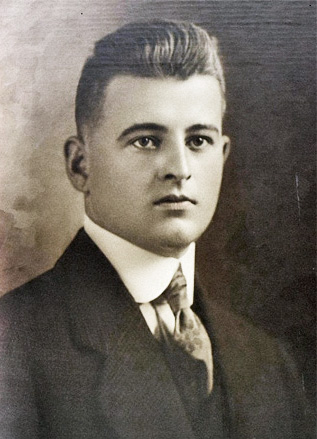
Karl E Ross was born June 27, 1894, in Petaluma, California to father David and mother Caroline. By the 1910 Census Karl and his family moved to Stockton. Karl was drafted and sent to Camp Lewis in Washington. He was one of the first 5% of Stockton's quota expected to serve. He was assigned to the 91st Division, 363rd Machine Gun Company. The 363rd shipped out of Hoboken, New Jersey, on July 7, 1918. The 363rd included other area young men from Stockton. Karl Ross was an admirable Soldier. While fighting in the European campaign, he was promoted to the rank of Sergeant just days before his death. His division fought in the Meuse-Argonne Offensive at the end of September where he was slightly wounded. His actions on October 31, 1918, at Ypres-Lys/Waregem in West Flanders Belgium, which resulted in his death. His Commander recommended him for the Distinguished Service Cross.
"At a distance of less than 200 meters from the enemy, Sgt Ross set up and directed the fire of his guns,
exposed during the whole operation to direct enemy fire, He killed one gunner and while searching for the
Hun on his flank, was killed himself."
He was awarded the honor posthumously, and the Cross is on display in the atrium of Karl Ross American Legion Post 16 which was established in 1934. Karl's body originally was buried by the chaplain of his division directly on the field where his body lay. He eventually was moved to Flanders Field American Cemetery in Waregem, Belgium, where he now rests in Plot B, Row 1 - Grave 3.
With great pride, dedication, and determination the American Legion Karl Ross Post 16 supports Veterans and the Community at large. Advocating for education, youth outreach, senior outreach, and Veteran support. We will strive to bring comradery, unity, and Americanism to our community. Bringing together all organizations, for profit and not for profit, to support the people of the San Joaquin County.
History of the American Legion
The American Legion was chartered by Congress in 1919 as a patriotic veterans organization. Focusing on service to veterans, servicemembers and communities. The Legion evolved from a group of war-weary veterans of World War I into one of the most influential nonprofit groups in the United States. Membership swiftly grew to over 1 million, and local posts sprang up across the country. Today, membership stands at nearly 2 million in more than 13,000 post worldwide. The posts are organized into 55 departments: one each for the 50 states, along with the District of Columbia, Puerto Rico, France, Mexico and the Philippines.
Over the years, the Legion has influenced considerable social change in America, won hundreds of benefits for veterans and produced many important programs for children and youth. Every day the Legion works on behalf of U.S. service men and women. It is recognized as a leader in transition assistance from military to civilian life, providing resources for careers, education, child care, Rehabilitation, National Security, Americanism, and Children & Youth.
Aug. 1921
The Legion's efforts result in the creation of the U.S. Veterans Bureau, forerunner of the Veterans Administration. Today,
the Legion continues to lobby for adequate funding to cover medical, disability, education and other benefits for veterans.
June, 1923
The first "Flag Code" is drafted during a Legion conference in Washington. Congress adopts the code in 1942. Today the
Legion is at the forefront of efforts to pass a constitutional amendment to protect the U.S. flag from physical desecration.
July, 1925
The Legion creates the American Legion Baseball program. Today more than 50 percent of Major League Baseball players
are graduates of the program. About 82,000 youths play on Legion-sponsored teams each year.
Sept. 1932
The Sons of the American Legion is officially recognized during the 1932 National Convention in Portland Ore.
June, 1935
The first American Legion Boys State convenes in Springfield Ill., to help youths gain an understanding of the structure
and operation of the federal government. The first Boys Nation, bringing together youth leadership from all Boys State
programs, convenes in 1946. Today, more than 19,500 young men participate in Boys State, and 98 in Boys Nation, from
49 of the 50 states.
June, 1944
President Franklin D. Roosevelt signs into law the original GI Bill, or Servicemen's Readjustment Act, ushering in monumental
changes in U.S. society. Higher education becomes democratized after 8 million veterans go to school on the GI Bill, get
better jobs, buy houses in the suburbs and raise families. For every dollar spent on educating veterans, the U.S. economy
eventually gets $7 back.
Jan. 1989
The Veterans Administration is elevated to Cabinet-level status as the Department of Veterans Affairs (VA). The Legion
fought hard for the change, arguing that veterans deserve representation at the highest levels of government.
Aug. 1994
The Legion announces the creation of the Citizens Flag Alliance, a coalition of organizations and individual citizens
united to work for a constitutional amendment to protect the U.S. flag from physical desecration. Since 1995, the
amendment has passed in the House by a supermajority six times: in 1995, 1997, 1999, 2001, 2003 and 2005. In 2006,
the amendment fell one vote short of passage in the Senate.
Oct. 2007
The American Legion National Executive Committee passes Resolution 35 and adopts The American Legion Riders as
a national program of The American Legion. The first American Legion Riders chapter was established by American Legion
Post 396 in Garden City, Mich., in 1993
June, 2008
President George W. Bush signs into law the Post-9/11 Veterans Educational Assistance Act, a next-generation GI Bill
strongly supported by the Legion. The bill renews the federal government's commitment to veterans by providing them
with substantially better education benefits. The Post-9/11 GI Bill took effect Aug. 1, 2009, and sent an unprecedented
number of veterans to college. Today, as at its formation, the Legion remains at the forefront of efforts to improve
education and other benefits for all veterans.
June, 2017
Created to hold VA employees more accountable, the Department of Veterans Affairs Accountability and Whistleblower
Protection Act of 2017 is passed by Congress in concert with The American Legion. A longtime goal of the Legion, this
legislation gives the VA secretary the authority to terminate the employment of VA employees who do not hold the standard
of the VA's missions, to help veterans. The American Legion worked hard with Congress, VA and others to create and pass
this much needed veteran-centric legislation.
American Legion Preamble
The American Legion Preamble to the Constitution
FOR GOD AND COUNTRY WE ASSOCIATE OURSELVES TOGETHER FOR THE
FOLLOWING PURPOSES:
To uphold and defend the Constitution of the United States of America;
To maintain law and order;
To foster and perpetuate a one hundred percent Americanism;
To preserve the memories and incidents of our associations in the Great Wars;
To inculcate a sense of individual obligation to the community, state and nation;
To combat the autocracy of both the classes and the masses;
To make right the master of might;
To promote peace and goodwill on earth;
To safeguard and transmit to posterity the principles of justice, freedom and democracy;
To consecrate and sanctify our comradeship by our devotion to mutual helpfulness.

The Four Pillars of the American Legion Pillar I – Veterans Affairs & Rehabilitation. VA Claims Backlog. Access to VA Health Care. ...
Pillar II – National Security. Support for the Troops. Size of the Armed Forces. ...
Pillar III – Americanism. Flag Protection. Illegal Immigration. ...
Pillar IV – Children & Youth. Catastrophic Illness. Intellectual Disabilities.

Compassionate Support for Veterans
We are committed to offering vital support services to veterans, helping them take steps toward a brighter future.
Through our programs and community, we strive to make a measurable impact on the lives of veterans.